
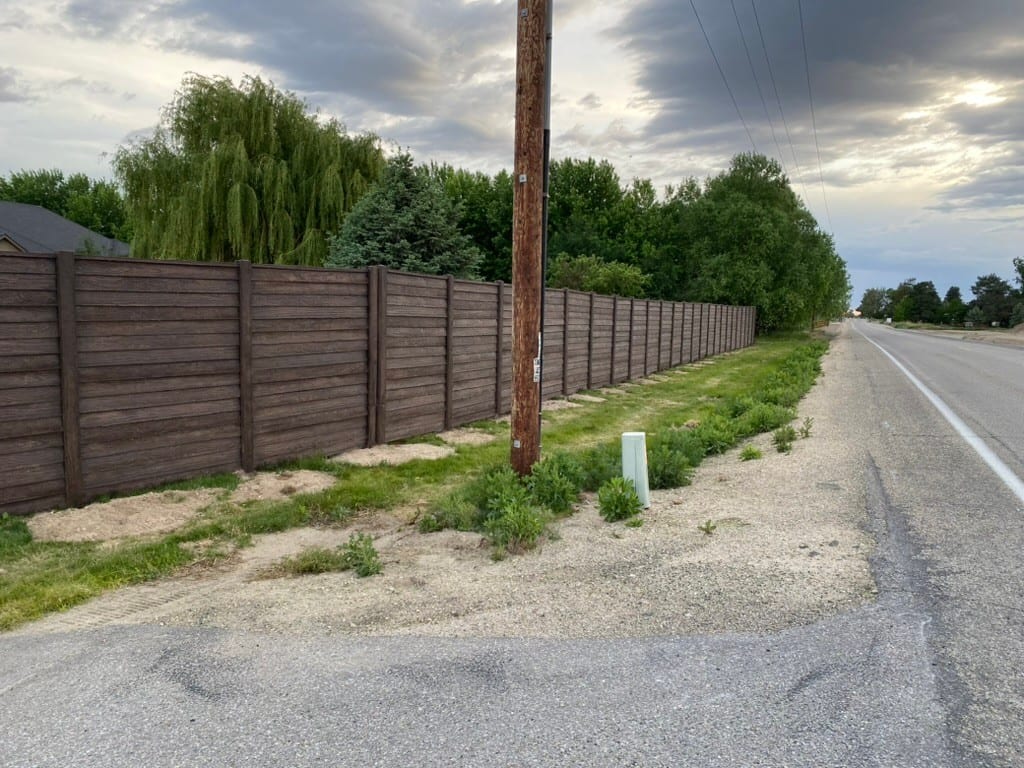
A sound barrier in Garden City, Idaho has to be designed around one specific property, because elevation, setback, and distance from the road decide how much noise a barrier can actually stop. Petrified Forest Boise builds its sound barriers in-house from the same proprietary concrete used across its fence lines, with the goal of reducing noise by up to 95%. Homes and businesses along Garden City's busy arterials, such as Chinden Boulevard and Glenwood Street, are where that design work tends to pay off most. Each barrier carries a lifetime warranty and a rating to withstand winds up to 115 miles per hour, and every project starts with a free on-site assessment.
A Small City With a Lot of Traffic
Garden City packs a lot into a compact footprint. Surrounded by Boise and stretched along the Boise River, it mixes older single-family homes, newer infill townhomes, riverside properties near the Greenbelt, and a long-standing base of light industrial and commercial lots. Running through all of it are arterials that carry steady traffic for much of the day.
Chinden Boulevard and Glenwood Street are the corridors most residents name first, but noise doesn't stop at the major roads. Commercial activity, delivery traffic, and cut-through routes affect blocks that never show up on a traffic map. For anyone whose backyard faces that activity, the question isn't whether noise exists but how much of it a fence can realistically remove.
That's the problem a dedicated sound barrier is built to solve. It's a different product from a standard privacy fence, and understanding why helps set realistic expectations before any design work begins.
Why a Privacy Fence and a Sound Barrier Aren't the Same Thing
Any solid concrete fence blocks some sound. Petrified Forest Boise's standard concrete fencing reduces noise as a natural byproduct of its dense, continuous panels, and for homes with moderate, incidental traffic noise that may be enough. A purpose-built sound barrier goes further because it's engineered to hit an acoustic target rather than simply mark a boundary.
The difference is in the design process. A sound barrier is planned around the property's elevation changes, lot setbacks, and proximity to the noise source, since those variables determine how tall it needs to be and exactly where it should sit. Two neighboring Garden City lots facing the same road can end up with different designs because one sits lower than the street or farther back from it.
For a deeper look at the physics, the explainer on how sound barrier fences work covers why mass, height, and continuity matter so much. The short version: gaps and shortcuts let sound slip around a barrier, which is why a guessed height rarely performs like a designed one.
Signs Your Property Needs More Than a Privacy Fence
Not every noisy property needs a dedicated sound barrier, and it's worth being honest about that. A few signs point toward one: you can't hold a normal conversation in the backyard during peak traffic, road noise is noticeable inside with the windows closed, or the property sits directly on an arterial with little or no setback.
If the noise is more of an occasional annoyance, a standard concrete fence often provides enough reduction while also delivering privacy, a lifetime warranty, and the same 115 mph wind rating. Being clear about which situation you're in helps the estimator recommend the right product rather than the biggest one.
Some owners find it useful to note when noise bothers them most for a week or two before the assessment. Patterns like early-morning delivery trucks or evening commuter traffic help shape where the barrier should go and how tall it needs to be.
Residential Lots Along the Arterials
Many Garden City homes sit close to the road with limited setback, which makes placement especially important. A barrier pushed tight to the property line may perform differently than one positioned to protect a specific patio, bedroom wall, or play area. Telling the estimator which part of the property you actually want quieter is one of the most useful things you can do.
Height limits and lot size also shape what's possible. A sound barrier generally needs enough height to break the line between the noise source and the space being protected, and that has to work within the rules that apply to the property. Petrified Forest Boise handles builder permits and utility locates as part of the project, so those constraints are addressed before anything is built.
Appearance matters on smaller urban lots, where the barrier may be one of the most visible features of the home. Custom color options help a tall concrete wall read as a finished part of the property instead of a highway-style structure.
Commercial and Mixed-Use Properties
Garden City's commercial and light industrial lots often border residential streets, and noise can travel in either direction. A business may want to screen customers or outdoor seating from road noise, or it may need to limit how much of its own activity reaches the homes next door.
Commercial and shared sound barrier projects can involve more complexity than a single residential lot, since the barrier may need to serve multiple units or satisfy site-specific requirements. The same core variables still apply, height, placement, and proximity, but the planning conversation often includes property managers or several stakeholders. Raising that early keeps the timeline realistic.
Businesses also tend to care about how a barrier looks from the street, since it becomes part of the property's first impression. A clean, custom-colored concrete surface tends to read as professional and permanent, which is usually the impression a commercial owner wants to give.
Find Out What Your Property Actually Needs
A free on-site assessment looks at your layout, elevation, and noise source before a design or price is set.
Request Your Free On-Site EstimateRiverside Lots and Wind Exposure
Properties near the Boise River and the Greenbelt bring a different set of considerations. Open river corridors can leave a tall barrier exposed to wind, and a sound barrier that can't stand up to Treasure Valley weather isn't solving the problem for long.
Every Petrified Forest Boise sound barrier is manufactured from the company's proprietary concrete and rated to withstand wind speeds up to 115 miles per hour. Prevailing wind direction and site details like irrigation are factored into the design, so the structure performs acoustically and structurally at the same time.
Riverside owners are often balancing noise against views, too. A barrier placed to block traffic on the street side can leave sightlines toward the river open, which is another reason a property-specific design beats a one-height-fits-all approach.
What Drives the Cost of a Garden City Sound Barrier
Sound barriers aren't priced at a flat rate, and that's intentional. A taller barrier needs more material and different structural considerations, and placement can change how much barrier a property needs to hit its target. Linear footage, site access, and obstacles along the line add to the picture, much as they would on any fence.
A dedicated barrier generally costs more than a standard concrete fence of the same length because of the acoustic design work involved. Where noise is a secondary concern, a standard concrete fence may deliver enough reduction on its own. The guide on sound barrier cost breaks down these variables in more detail.
Many owners save by limiting the barrier to the side that actually faces the road and using a standard concrete fence elsewhere. That puts the design budget where it delivers results instead of across a boundary that doesn't need it. It's also worth asking about the current 10% project discount when you schedule.
Common Mistakes With Guessed or Off-the-Shelf Barriers
The most common mistake is choosing a height without a design. A barrier that's too short for the property's elevation, or placed in the wrong spot relative to the road, can underperform badly compared with a properly designed one built for a similar cost.
Gaps are the second. Sound travels through openings at the bottom of a fence, between panels, and around ends that stop short. A continuous concrete barrier avoids most of those weak points, but placement around gates, driveways, and property corners still needs careful planning.
The third is choosing a lightweight material that can't handle wind. A tall barrier catches a lot of it, so structural strength matters as much as acoustic performance. That's why every Petrified Forest Boise barrier carries the same 115 mph wind rating as its concrete fencing.
Choosing a Garden City Fence Contractor for Acoustic Work
When comparing a Garden City fence contractor's quote for a sound barrier, ask what noise reduction the proposed design is expected to achieve and what site factors informed it. A quote that skipped the assessment is often just a tall fence with a guess attached.
Confirm the manufacturing source, wind rating, and warranty, too. Petrified Forest Boise manufactures its barriers in-house, backs them with a lifetime warranty, and installs them with crews trained through a year-long apprenticeship under a master craftsman. The company has served the Treasure Valley since 2004 and is a Certified Buckley Fence Installer.
Reviews are a reasonable gut check as well. Customers of the company specifically mention the effectiveness of its noise reduction, along with clear communication and on-time delivery.
Living on Chinden, Glenwood, or Another Busy Street?
Talk through placement, height, and what quiet would look like for your property.
Call or Text (208) 738-9154What Happens During the Assessment
The process starts with a free on-site visit. The team looks at where the noise comes from, how your property sits relative to the road, and which outdoor or indoor spaces matter most to you. The mobile showroom lets you see real finishes at the same time, so design and appearance get settled together.
From there, the barrier is designed, permits and utility locates are handled, and the panels are produced in-house before installation. Because the work depends on design, the timeline varies by project, and the estimate is where a realistic schedule is set. Properties just across the line in Boise follow the same process through the company's Boise fence installation service area.
If you share a boundary with a neighbor dealing with the same noise, it may be worth talking with them before the assessment. A barrier that spans both properties can sometimes be planned more efficiently than two separate projects, and it avoids a weak point where one barrier ends and the other begins.
Bring any specifics that matter to you, such as the hours when traffic is worst or a room that faces the road. Those details help shape a barrier that solves your problem instead of a generic one.
The Long-Term Value of a Quieter Property
A sound barrier is a long-term investment, and the lifetime warranty means the acoustic performance you paid for isn't a result that fades as the material ages. A barrier that had to be repaired or replaced after a decade would effectively double the real cost of quiet.
It also changes how a property feels day to day. A backyard that was too loud to use becomes usable, and a bedroom facing the street becomes easier to sleep in. Those benefits are hard to put a number on, but they're usually why Garden City owners start looking in the first place.
For homes on busy corridors, that quiet can also become part of what makes the property appealing to the next owner, which is worth keeping in mind if a sale is somewhere on the horizon.
Frequently Asked Questions
Yes. Petrified Forest Boise designs and installs sound barriers for residential and commercial properties in Garden City. Every project begins with a free on-site assessment of the property and its noise source.
Petrified Forest Boise designs its sound barriers with the goal of reducing noise by up to 95%. Actual results depend on getting height, placement, and proximity to the noise source right, which is why each barrier is designed for its specific property.
It can be for moderate, incidental noise, since solid concrete naturally blocks some sound. For properties directly on a busy arterial, a dedicated sound barrier usually delivers much more meaningful reduction.
Because the design changes with each property's elevation, setback, and distance from the road. Height and placement determine both performance and cost, so a real price comes after the on-site assessment.
Sound barriers are manufactured in-house from the same proprietary concrete as the company's other fence lines. They're backed by a lifetime warranty and rated to withstand wind speeds up to 115 miles per hour.


