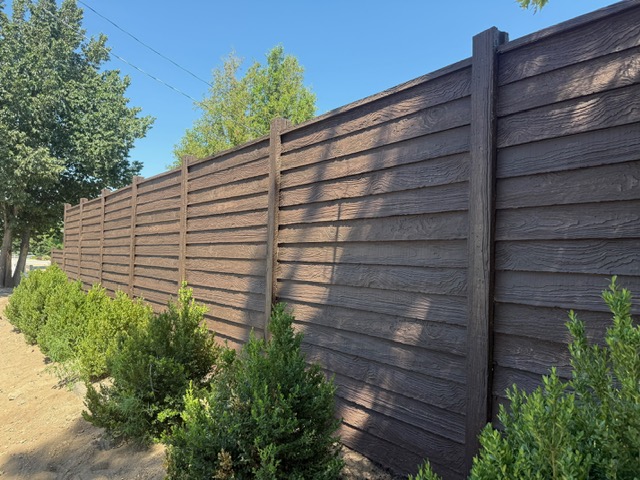
Concrete fencing offers the most complete privacy solution in the Treasure Valley, since solid, continuous panels eliminate sightlines entirely without the gaps that eventually develop in a wood fence over time. A hybrid fence delivers a similar level of privacy with cedar panels for a more traditional appearance, while still relying on Petrified Forest Boise's concrete posts for structural durability. Both options are backed by a lifetime warranty and rated to withstand wind speeds up to 115 miles per hour, which matters for a privacy fence that's often taller and catches more wind than a standard boundary fence. Wood privacy fencing remains a familiar, lower-cost option, but according to HGTV it lasts up to 20 years with proper maintenance, and that maintenance affects how consistently it maintains true privacy over time. If you're comparing privacy fence materials for a Treasure Valley property, here's how they actually stack up, including how height requirements and different areas of your property can affect the right material choice.
What a Genuine Privacy Fence Actually Requires
A true privacy fence needs to do more than reach a certain height, it needs to maintain a continuous, gap-free surface over the entire life of the fence. Even a tall fence loses its privacy value if gaps develop between boards or panels over time, since those gaps create sightlines that undermine the whole purpose of the installation.
This is where material choice becomes the deciding factor in a privacy fence conversation. Some materials are built to maintain that continuous surface indefinitely, while others are prone to developing exactly the kind of gaps that erode privacy as they age.
It's worth thinking about this the same way you'd think about any barrier meant to last: the question isn't just whether it blocks the view on day one, but whether it's still doing that job reliably five, ten, or twenty years later without you having to think about it.
Why Concrete Delivers the Most Complete Privacy
A concrete fence from Petrified Forest Boise provides a solid, continuous barrier with no sight lines, and that continuity doesn't degrade over time the way wood can. Concrete panels don't shrink, warp, or separate at the seams, so the privacy the fence provides on installation day is the same privacy it provides years later.
That consistency, combined with the lifetime warranty and 115 mile-per-hour wind rating, makes concrete the most complete privacy solution among the materials Petrified Forest Boise offers, particularly for homeowners who want a permanent solution rather than one that needs monitoring over time.
Custom color options mean this level of privacy doesn't have to come at the expense of curb appeal either, since the same solid panel that blocks every sightline can also be finished to complement the rest of the property.
How a Hybrid Fence Compares for Privacy
A hybrid fence delivers strong privacy as well, using cedar panels between concrete posts to create a solid visual barrier with a more traditional wood appearance. Because the structural posts are concrete rather than wood, the system avoids the post-level failure that can eventually compromise a privacy fence's alignment and coverage.
The cedar panels themselves are the part of the system most similar to an all-wood privacy fence in terms of material behavior, though they benefit from a structural post system that isn't subject to the same freeze-thaw and moisture issues affecting wood posts.
For homeowners who specifically want the warmth of a wood look but are wary of an all-wood privacy fence's long-term reliability, this is often the more comfortable middle ground between concrete's permanence and wood's traditional appearance.
Wood's Privacy Trade-Offs Over Time
An all-wood privacy fence is a familiar, often lower-cost option, but according to HGTV, it lasts up to 20 years with proper maintenance, and that maintenance directly affects how well it maintains true privacy. As wood boards dry, shrink, and occasionally warp, small gaps can develop that reduce the fence's effectiveness as a complete visual barrier.
This doesn't make wood a bad choice outright, but it does mean the privacy benefit is more dependent on ongoing maintenance than it would be with a concrete or hybrid system, where the structural material itself isn't changing shape over time.
For homeowners willing to stay on top of that maintenance schedule, wood remains a genuinely workable privacy option. The trade-off is simply that the privacy benefit requires more active upkeep to preserve than concrete's essentially maintenance-free approach.
Compare Privacy Fence Materials in Person
See real concrete, hybrid, and rail fence samples with a free on-site estimate and mobile showroom visit.
Request Your Free On-Site EstimateWhen Privacy and Noise Reduction Overlap
For properties near busy roads, privacy and noise reduction often go hand in hand, since the same solid, continuous concrete surface that blocks sightlines also helps absorb and block sound. A standard concrete fence can offer both benefits together, though a dedicated sound barrier is the better choice if noise reduction specifically, rather than privacy, is the primary concern.
It's worth clarifying which benefit matters most for your property before finalizing a design, since a fence optimized purely for privacy and one optimized specifically for acoustic performance can look slightly different depending on height and placement.
Bringing up both goals directly during your estimate, even if one is clearly the priority, helps make sure the final design doesn't accidentally underperform on the secondary benefit you were also hoping to get from the same fence.
Custom Colors and Privacy Fence Aesthetics
A privacy fence doesn't have to look purely functional. Concrete and hybrid fencing from Petrified Forest Boise are available in a range of custom colors, which means a privacy fence can complement a home's exterior or meet HOA requirements while still delivering complete coverage.
This matters especially for privacy fences, since they tend to be more visually prominent than a shorter boundary fence simply because of their height. Getting the color right has a bigger impact on the property's overall look for a taller, more visible fence.
A well-chosen color turns what could be an imposing, purely utilitarian structure into something that actually enhances the property's overall design, rather than just solving a privacy problem at the expense of curb appeal.
Choosing the Right Material for Your Property
If permanent, maintenance-free privacy is the priority, a concrete fence delivers the most complete and consistent solution. If you want that same privacy with a more traditional wood appearance, a hybrid fence offers a strong middle option. And if upfront cost is the primary constraint and you're comfortable with an ongoing maintenance schedule, an all-wood privacy fence remains a reasonable choice.
The best way to compare these options for your specific property is a free on-site estimate, where you can see real samples of each material and get an accurate cost comparison based on your actual fence line. There's genuine value in seeing all three materials side by side before committing to any single direction.
How Height Requirements Interact With Privacy Design
Privacy fences are often subject to local height restrictions, which can vary depending on whether the fence is in a front yard, backyard, or along a specific type of property line. Before finalizing a privacy fence design, it's worth understanding what height is actually allowed for your specific situation, since that constraint affects how much privacy coverage the fence can realistically provide.
Petrified Forest Boise's process, including the permit coordination that's part of every project, helps make sure the finished fence complies with applicable height requirements rather than running into a compliance issue after installation.
Combining Privacy Fencing With Other Property Needs
Privacy isn't always the only goal for a given section of fence line. Some properties combine a privacy-focused design along a backyard boundary with a more open rail fence style along a front or side property line where visibility matters more than seclusion. Others pair a privacy fence with a dedicated sound barrier section where a property faces both a neighbor's yard and a busy road at different points along the same perimeter.
Thinking through what each section of your property actually needs, rather than defaulting to one fence style everywhere, tends to produce a more functional and better-looking result than treating the entire property line as a single, uniform decision.
Want Privacy and Noise Reduction Together?
Talk through whether a standard concrete fence or a dedicated sound barrier fits your property best.
Call or Text (208) 738-9154Different Privacy Needs for Backyards vs. Front-Facing Areas
A backyard privacy fence is usually focused on creating a fully enclosed, secluded space for outdoor living, which tends to call for maximum height and complete coverage. A front-facing privacy need is often more about softening visibility from the street while still maintaining some level of openness, which can call for a different height or design approach than a backyard installation.
Being clear about which of these goals applies to a given section of your property helps guide both the material choice and the specific design, since a one-size-fits-all approach to privacy doesn't always serve every part of a property equally well. Discussing both areas during the same estimate, even if they'll be built at different times, helps keep the overall look and material choices consistent across the property.
Getting an Accurate Privacy Fence Estimate
The clearest way to compare concrete, hybrid, and wood privacy fencing for your specific property is a free on-site estimate, where Petrified Forest Boise's mobile showroom lets you see real samples of each material in the actual setting where the fence will go. That direct comparison tends to make the decision clearer than evaluating photos or general descriptions online.
Come prepared with a sense of which sections of your property need full privacy versus partial screening, since that distinction affects both the design and the final cost of the project.
The Bottom Line on Choosing a Privacy Fence Material
Every privacy fence material discussed here can technically deliver privacy on installation day. The real difference between them is whether that privacy holds up consistently over the years you own the property, and that's where concrete and hybrid fencing separate themselves from wood specifically because they don't rely on ongoing maintenance to maintain a continuous, gap-free surface.
Whichever direction you lean, getting real samples in front of you during an on-site estimate is the best way to confirm the choice feels right for your specific property before committing to a full installation.
A privacy fence is also one of the more permanent decisions you'll make about a property's exterior, since it's expensive and disruptive to replace once installed. Taking the time to compare materials thoroughly upfront is worth the extra step before committing to any single option.
The right choice ultimately comes down to how much you value permanence versus upfront cost, and there's a reasonable answer at either end of that spectrum depending on your specific situation and timeline.
Frequently Asked Questions
Concrete fencing offers the most complete privacy, since its solid, continuous panels don't develop the gaps that can eventually affect a wood fence's coverage over the years of ownership.
Yes, a hybrid fence's cedar panels create a solid visual barrier as well, with the added benefit of concrete posts that avoid wood's structural failure points.
It can. As wood boards shrink or warp with age, small gaps can develop that reduce the fence's effectiveness as a complete visual barrier across the entire fence line.
Yes. A solid concrete fence naturally helps absorb and block some noise, though a dedicated sound barrier is the better option if noise reduction is the primary concern.
Yes. Concrete and hybrid privacy fencing from Petrified Forest Boise come in a range of custom colors to match a home's exterior or meet HOA requirements.


